

If you searched for an audit review, you're most likely weighing three accountant-delivered services: an audit, a review, or a compilation. What separates them is the assurance you get. An audit gives reasonable assurance, a review gives limited assurance built on inquiry and analytics, and a compilation gives none. All three look only at the books, so none will tell you why growth has stalled.
TL;DR:
- Assurance is what you pay for. An audit gives reasonable assurance, a review gives limited assurance, and a compilation gives no assurance at all.
- Pick the level the reader demands. Buy an audit only when a lender, investor, regulator or buyer requires one; otherwise a review or compilation is usually enough.
- Audit opinions come in four kinds. Unmodified, qualified, adverse, and disclaimer. Only the first is a clean bill of health.
- Timing changes the result. An audit engaged after year-end can lose the chance to observe inventory counts, which can lead to a qualified opinion.
- Financial audits don't diagnose growth. If revenue is flat and the books are clean, you need a business audit of positioning, marketing, sales and customers.
Table of Contents
- Audit vs Review vs Compilation: What Each One Gives You
- Levels of Assurance, and the Audit Risk Model Behind Them
- Compilation Report Example: What the Wording Actually Says
- What an Audit Workpaper Looks Like, Line by Line
- The Five Stages of an Audit, and the Four Opinions at the End
- Audit Review Inside a Firm: When Someone Checks the Auditor's Work
- Which One to Buy: My Picks by Situation
- Why a Financial Audit Review Won't Find What's Capping Your Growth
- Get a Scored Diagnosis of Your Growth Blind Spot in Ten Minutes
- Frequently Asked Questions
- Sources
Audit vs Review vs Compilation: What Each One Gives You

The three services sit on a ladder. Each step up adds work for the accountant, cost for you, and confidence for whoever reads the statements.
| Compilation | Review | Audit | |
|---|---|---|---|
| Assurance | None | Limited ("negative" assurance) | Reasonable (high, not absolute) |
| What the accountant does | Formats your numbers into financial statements | Asks questions and runs analytical comparisons | Tests balances against outside evidence, counts, confirms and inspects |
| Report conclusion | No opinion, no conclusion | "Not aware of any material modifications needed" | A formal opinion on fair presentation |
| Who usually asks for it | Owners, small lenders, internal use | Banks, bonding companies, some investors | Regulators, larger lenders, investors, acquirers |
| Independence required | Not for the compilation itself, but disclosed | Yes | Yes |
What is the difference between a financial review and an audit? A review is a conversation plus number-crunching. The accountant interviews management and compares this year to last year, to budget, and to industry patterns, looking for anything that seems off. An audit goes outside the building: the accountant confirms balances with banks and customers, observes inventory, inspects documents, and tests the controls behind the numbers. The International Auditing and Assurance Standards Board frames this as reasonable assurance for audits and limited assurance for review engagements.
Levels of Assurance, and the Audit Risk Model Behind Them
"Reasonable assurance" is a technical phrase. It means the auditor has gathered enough evidence to drive the risk of a wrong opinion down to a low level. It does not mean zero risk, which is why an audit can still miss fraud.
The audit risk model explains how that works. Audit risk equals inherent risk times control risk times detection risk (AR = IR × CR × DR). Inherent risk is how likely the account is to be wrong before any controls. Control risk is the chance your internal controls fail to catch it. Detection risk is the chance the auditor's own testing misses it.
To hold audit risk at 5% when inherent risk is 60% and control risk is 50%, detection risk must come down to about 17%, because 0.05 ÷ (0.60 × 0.50) = 0.167.
That arithmetic is why messy books cost more to audit. When your controls are weak, the auditor can't lean on them, so they test more items and charge for the extra hours. The sampling and testing depth follows from risk assessment, a process the IAASB lays out in its standards on identifying and assessing risks of material misstatement.
Compilation Report Example: What the Wording Actually Says
What is a compilation report in accounting? It is a short letter attached to financial statements stating that an accountant helped present management's numbers and checked nothing. The compilation report meaning comes down to one sentence: you are reading management's figures, formatted by a professional.
Here is a paraphrase of the typical wording under U.S. standards from the AICPA, which is an illustration and not a template to copy:
- Scope statement. "We have compiled the accompanying statements of the company as of December 31, for the year then ended."
- Responsibility. Management is responsible for the statements and for the accuracy of the underlying information.
- The disclaimer. "We did not audit or review the financial statements, nor were we required to perform any procedures to verify the accuracy or completeness of the information provided by management. Accordingly, we do not express an opinion, a conclusion, nor provide any form of assurance."
Compare that to a review report's closing line, which says that based on the review, the accountant is not aware of any material modifications that should be made for the statements to conform with the applicable framework. One phrase gives you something a banker can lean on; the other gives them a nicely formatted spreadsheet.
What an Audit Workpaper Looks Like, Line by Line
What does an audit workpaper look like? It looks like a structured page, usually a spreadsheet or a template inside audit software, that records one test from start to finish so another professional could re-perform it. The IAASB's standard on audit documentation (ISA 230) requires enough detail for an experienced reviewer with no prior connection to the engagement to understand what was done.
A typical workpaper contains:
- Header block. Client name, period end, the account being tested, who prepared it and when, and who reviewed it and when.
- Index reference. A code such as "C-2" that links the page to the trial balance and to related pages.
- Objective. One line, such as "Confirm that accounts receivable exist and are stated at collectible value."
- Population and sample. The ledger total, the number of items selected, and how they were chosen.
- Procedure and results. A row per item, with tick marks (small symbols) showing what was agreed to the invoice, the bank confirmation, or the subsequent receipt.
- Exceptions. Anything that didn't tie out, with the explanation and any proposed adjustment.
- Conclusion. A sentence stating whether the objective was met.
The sign-offs matter as much as the testing. An unsigned workpaper is treated as work that was not done.
The Five Stages of an Audit, and the Four Opinions at the End

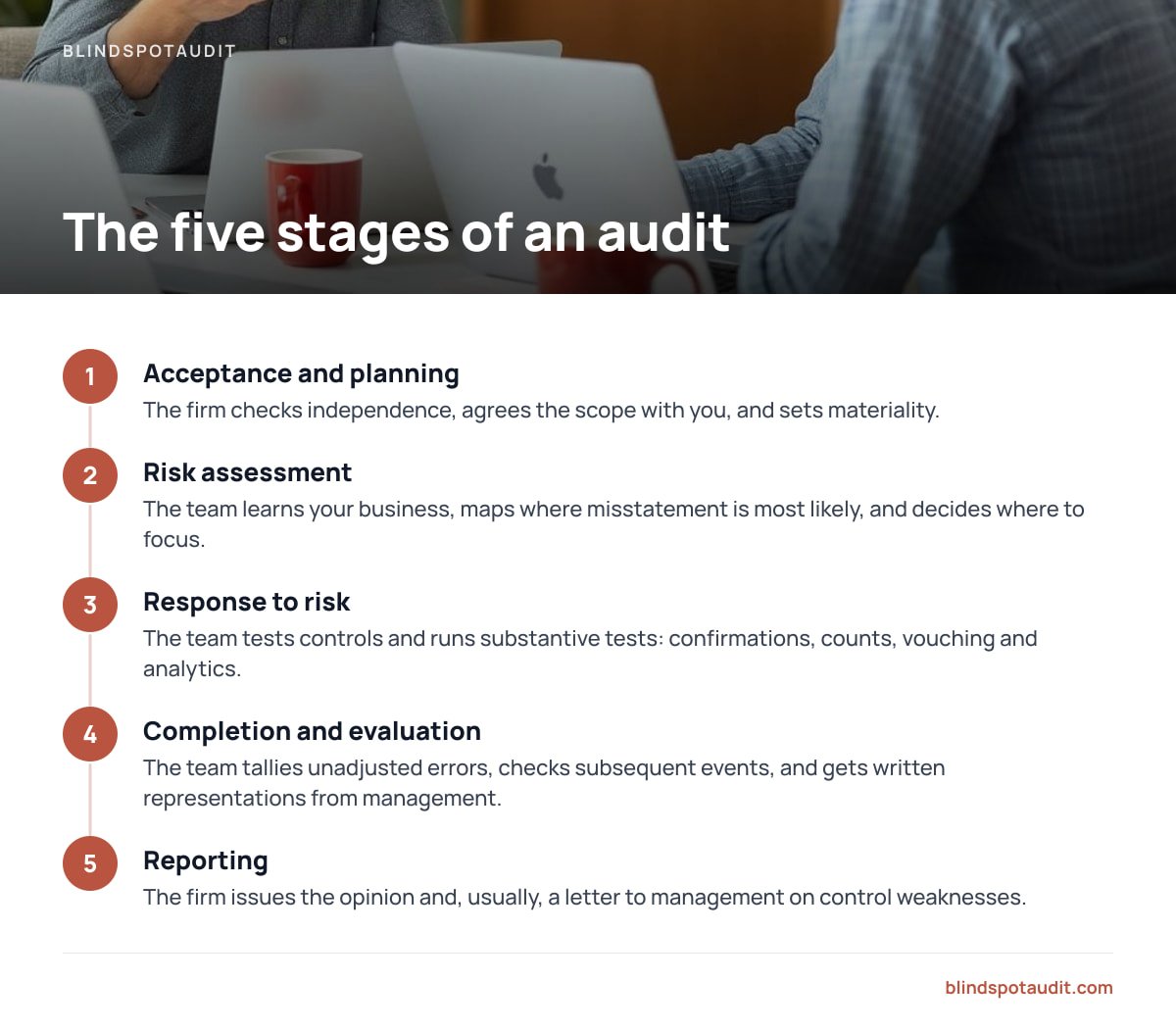
What are the 5 stages of audit? The standards don't number them, so firms teach slightly different versions. The most common five are:
- Acceptance and planning. The firm checks independence, agrees the scope with you, and sets materiality, the size of error that would change a reader's decision.
- Risk assessment. The team learns your business, maps where misstatement is most likely, and decides where to focus.
- Response to risk. The team tests your controls and runs substantive tests on balances and transactions: confirmations, counts, vouching and analytics.
- Completion and evaluation. The team tallies unadjusted errors, checks subsequent events, and gets written representations from management.
- Reporting. The firm issues the opinion and, usually, a letter to management on control weaknesses.
What are the four types of audit opinions? They follow the IAASB's reporting standards, ISA 700 and ISA 705:
- Unmodified (unqualified). The statements are fairly presented. This is the clean opinion.
- Qualified. The statements are fairly presented except for a specific material issue, or the auditor couldn't test one area but the effect isn't pervasive.
- Adverse. The misstatements are both material and pervasive. The statements can't be relied on.
- Disclaimer of opinion. The auditor couldn't gather enough evidence and the possible effects are pervasive, so no opinion is given.
Pro Tip: Engage your auditor before year-end, not after. If the audit starts after the physical inventory count, the auditor can't watch the count and may not be able to substitute other evidence. That is a classic route to a qualified opinion even when nothing is wrong in your books. A two-hour conversation in October can save you a modified report in March.
Audit Review Inside a Firm: When Someone Checks the Auditor's Work
"Audit review" has a second meaning that the ranking pages mostly skip. Inside an audit firm, it is the layered check on the audit team's own work. A senior reviews the staff's workpapers, a manager reviews the senior, and the engagement partner reviews the file before signing. For higher-risk audits there is often an independent second-partner review of the opinion.
Every workpaper carries a reviewer sign-off and a date, and that sequence is part of the evidence. There is also a third meaning in internal audit, where the Institute of Internal Auditors sets practice standards for reviewing controls and operations inside a company rather than reporting on statements to outsiders. If a vendor offers you an "audit review," ask which of the three they mean before you pay for anything.
Which One to Buy: My Picks by Situation
I'd decide by who is asking for the statements.
- You need statements for your own use or a friendly lender. Buy a compilation. Paying for assurance nobody reads is waste.
- A bank, bonding company or landlord asks for "reviewed" statements. Buy a review, and get the request in writing first. Many owners buy audits when a review would have satisfied the covenant.
- An investor, regulator or acquirer demands audited statements. Buy the audit, and engage the firm before year-end.
- None of the above applies. Don't buy any of them for growth. They tell you whether the numbers are fairly stated, not whether the business is pointed at the right customers.
The ranking pages miss that last point. A clean audit opinion can sit on top of a business with a muddy positioning story, a leaky sales process and revenue concentrated in three customers. The statements are accurate and the business is still stuck. If you want the longer argument, see Business Growth: Find What's Capping Yours Before You Spend More, and for the customer-side numbers see Customer Retention Rate: Formula, Benchmarks and When 80% Is Bad.
A clean audit opinion says your statements are fairly presented. It says nothing about whether anyone wants what you sell.
Why a Financial Audit Review Won't Find What's Capping Your Growth

Accountants test whether recorded transactions are real and complete. They don't test whether your offer is distinct, your lead flow is healthy, or your best customers are the ones you are chasing. Those are business-audit questions, and they sit in four areas:
- Positioning. Can a stranger say in one sentence why they'd choose you? If your pricing power is weak, see How to Raise Prices Without Losing Customers: The Math First.
- Marketing. Do you know which channel produces customers, not just clicks? The case for focus is in Small Business Marketing: The Strategy That Actually Works.
- Sales. Where do qualified leads stall: follow-up, pricing conversation, or close?
- Client base. How concentrated is revenue, and how many customers come back?
The accounting versions of an audit review are regulated and standardized. The business version is neither, so quality varies wildly. Look for one that gives you a score, names a single weakest area, and tells you what to fix first, rather than a forty-page deck.
Get a Scored Diagnosis of Your Growth Blind Spot in Ten Minutes
If your financials are fine and growth isn't, the missing piece is a business audit. Blindspotaudit sells short, self-serve audits for exactly that: USP & Positioning, Marketing, Sales Force and Client Base, each $67. You answer questions for about ten minutes and get a plain-English score plus the one fix worth doing first, with no sales call. Not sure where to start? The Free Blind Spot Checklist points you at the weakest area. The complete analysis of all four audits is $197, with an optional $120 video review.
One limit to know: this is not a financial audit and gives no assurance of any kind. The score is built from your own answers, so it is only as honest as you are, and it won't replace the review or audit your lender or investor requires. Check the scope of each audit on the site before you buy.
Frequently Asked Questions
What is the difference between a financial review and an audit?
A review gives limited assurance based mainly on inquiries and analytical procedures. An audit gives reasonable assurance by testing balances against outside evidence such as confirmations, inventory counts and source documents. The audit report states a formal opinion, while the review report states only that the accountant isn't aware of needed modifications.
What are the four types of audit opinions?
The four types are unmodified, qualified, adverse and disclaimer of opinion. Unmodified means the statements are fairly presented. Qualified, adverse and disclaimer are modified opinions used when there are material misstatements or the auditor couldn't gather enough evidence.
What does an audit workpaper look like?
It's a structured page recording one test: a header with preparer and reviewer sign-offs, an index reference, the objective, the sample, a row-by-row results table with tick marks, any exceptions, and a conclusion. The standard is that an experienced outsider could follow what was done without asking anyone.
What is a compilation report in accounting?
A compilation report is a short letter from an accountant stating that management's financial information was put into statement form. It explicitly gives no opinion, no conclusion and no assurance, because the accountant did not verify the underlying data.
What are the 5 stages of an audit?
Commonly they are acceptance and planning, risk assessment, response to risk through controls and substantive testing, completion and evaluation, and reporting. Auditing standards don't fix a numbered list, so some firms group the stages differently.
Sources
- International Standards on Auditing (ISA 230, 700, 705) and ISRE 2400 | International Auditing and Assurance Standards Board (IAASB)
- Statements on Standards for Accounting and Review Services (SSARS) | AICPA & CIMA
- International Professional Practices Framework | The Institute of Internal Auditors
Leave a Reply