

Small business marketing is not a checklist of tactics to try. It is knowing exactly who buys from you, why, and which single channel reaches them, before you spend another dollar on ads or content. Most small businesses don't fail from doing too little marketing. They fail from marketing confidently to the wrong person in the wrong place. The fix starts with diagnosis, not more activity.
TL;DR:
- The best small business marketing strategy starts with one clearly defined customer and one proven channel, not a dozen half-tried tactics.
- The 7 P's (Product, Price, Place, Promotion, People, Process, Physical Evidence) matter most for service businesses, where Price and Place alone miss half the buying decision.
- The 5 C's (Company, Customers, Competitors, Collaborators, Climate) are the audit to run before you spend a dollar, not after a campaign flops.
- Free advertising exists (Google Business Profile, Nextdoor, local groups), but "free" still costs the time to maintain it consistently, which is where most owners quit.
- SCORE's benchmark puts marketing spend at 7 to 8 percent of revenue for established businesses. Most small businesses spend far less, then wonder why growth stalls.
Table of Contents
- Marketing Activity Isn't the Same Thing as a Marketing Strategy
- The Best Small Business Marketing Strategy Starts With One Customer, Not Ten Tactics
- The 7 P's of Marketing, Applied to a Business With No Marketing Department
- The 5 C's of Marketing: The Audit You Run Before You Spend a Dollar
- Where to Advertise a Small Business for Free (and What "Free" Actually Costs)
- The Mistake That Quietly Caps Growth Before You Notice It
- Find the One Fix Worth Doing First
- Frequently Asked Questions
- Sources
Marketing Activity Isn't the Same Thing as a Marketing Strategy
Posting three times a week, running a boosted Facebook post, and printing new flyers feels like marketing, but it is motion, not strategy. A strategy names one customer, one promise, and one channel, then measures whether that combination produces sales. Activity produces a busier calendar.
The owners who struggle most with marketing are scattered, not lazy. They're on four platforms at once, each one half-maintained, none of them tied to a specific customer or a specific result. That scatter usually comes from not knowing which weak spot to fix first.
The Best Small Business Marketing Strategy Starts With One Customer, Not Ten Tactics

If someone forces you to pick exactly one small business marketing strategy, pick this: define the narrowest version of your best customer, find the one place they already pay attention, and put a specific, trackable offer in front of them there. Until that loop is proven to work, everything else is a distraction.
The U.S. Small Business Administration's guidance on building a marketing plan puts the customer, not the product, at the center of the plan. A product can be marketed a dozen different ways, but only a few of them will match how your specific buyer makes decisions. Broad targeting feels safer because it avoids picking a lane, but it is riskier: it spreads a small budget across people who were never going to buy, and it gives you no clean signal about what's working.
Pro Tip: When you're testing a new channel, test one channel with two different offers instead of two channels with the same offer. If you split budget across two channels, a win tells you almost nothing, because you can't tell whether the channel or the offer did the work. A win inside one channel, tested against itself, tells you what to scale.
The 7 P's of Marketing, Applied to a Business With No Marketing Department
The original marketing mix had four P's (Product, Price, Place, Promotion), developed in the 1960s for physical goods sold off a shelf. Services don't sell the same way, so the model was extended in 1981 to add People, Process, and Physical Evidence. A haircut or a consulting session can't be marketed with the same four levers as a bag of flour.
The 4 P's cover what you sell and how. The 3 P's added in 1981 (People, Process, Physical Evidence) exist because a service is bought on trust, not packaging.
| The P | What It Covers | Where Small Businesses Usually Drop It |
|---|---|---|
| Product | The specific thing solving the specific problem | Too broad: "we do everything" instead of one clear specialty |
| Price | What you charge and what it signals | Priced to match competitors instead of the value actually delivered |
| Place | Where and how customers can buy | Online store with no local pickup, or a local shop with no online presence |
| Promotion | How people find out you exist | One channel running on autopilot with no fresh offer in months |
| People | Who delivers the experience | Great marketing undone by a slow or inconsistent front-line team |
| Process | How a customer moves from interest to purchase | No clear next step after the ad, just a homepage with ten options |
| Physical Evidence | The tangible proof the service happened | No reviews, no before/after, no visible signal that others were happy |
Most small businesses over-invest in Promotion and under-invest in Process and Physical Evidence. A great ad pointed at a confusing checkout, or a sales call with no proof of past results, wastes the budget the Promotion line just spent.
The 5 C's of Marketing: The Audit You Run Before You Spend a Dollar
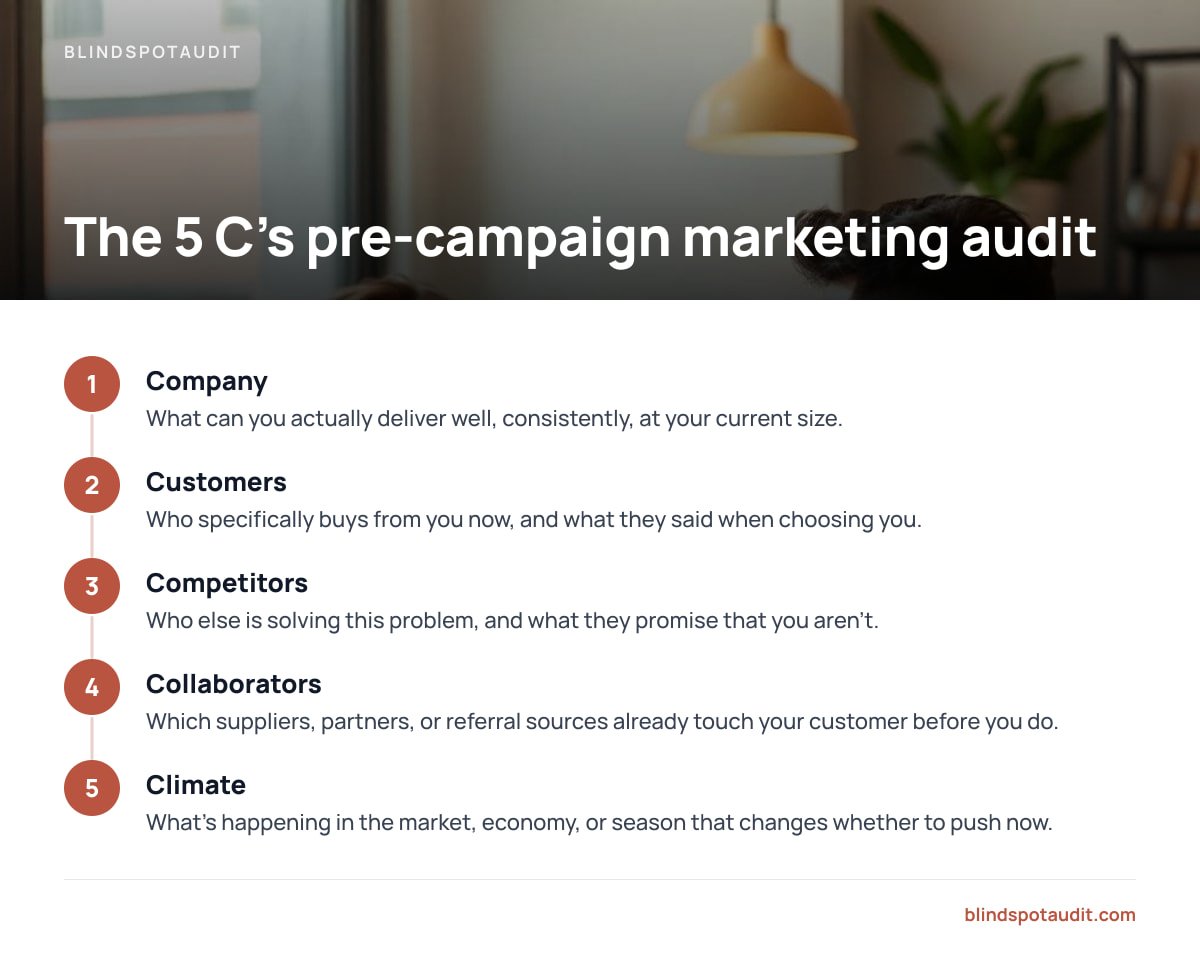
The 5 C's (Company, Customers, Competitors, Collaborators, and Climate) form a situational audit, meant to be done before a campaign, not after one underperforms. Each one answers a different question, and skipping any of them is usually what makes a "good idea" marketing campaign quietly fail.
- Company. What can you deliver well, consistently, at your current size? Leave out what you wish you could deliver.
- Customers. Who specifically buys from you now, and what did they say when they chose you over the alternative?
- Competitors. Who else is solving this problem, and what are they promising that you aren't?
- Collaborators. Which suppliers, partners, or referral sources already touch your customer before you do?
- Climate. What's happening in the broader market, economy, or season that changes whether now is the right time to push?
Running this audit takes an afternoon. Campaigns that looked great on a whiteboard and land flat were usually built on an assumption about the Customer or the Climate that turned out to be wrong.
Where to Advertise a Small Business for Free (and What "Free" Actually Costs)

Free advertising exists, but it takes effort. Every option below trades cash for time, and that time has to be spent consistently to work.
- Google Business Profile. A complete, actively updated profile is often the highest-leverage free listing a local business has, since it shows up directly in map and search results where people are already looking to buy. Google's own guidance for Business Profiles says that profiles with photos, hours, and regular posts perform better than static ones.
- Nextdoor for Business. A free business page on Nextdoor puts you in front of neighbors actively asking for local recommendations. That converts differently than cold audience ads because the intent is already there.
- Niche directories and associations. Industry-specific directories and local chamber listings rarely drive much traffic on their own, but they build the backlink and citation signals that help your Google listing rank in the first place.
- Community groups. Local Facebook groups and subreddits built around a city or neighborhood reach people who are already filtering for "local business." Most of these groups have strict no-self-promotion rules, so showing up with a helpful answer works better than posting an ad.
- Customer reviews and referral asks. Asking a satisfied customer directly for a review or an introduction costs nothing but a short conversation. It produces the kind of Physical Evidence the 7 P's table above flags as commonly missing.
SCORE, the nonprofit small-business mentoring network, points established businesses toward 7 to 8 percent of gross revenue as a marketing budget. Newer businesses are often told to spend closer to double that while they're still building visibility.
The Mistake That Quietly Caps Growth Before You Notice It
The most common blind spot is declaring a channel "working" because it produces likes, followers, or traffic, without checking whether any of that turns into paying customers. A page with growing engagement and flat revenue is not a marketing win. It suggests the Promotion is disconnected from the Process.
The Content Marketing Institute's long-running research on content strategy is relevant here: businesses with a documented content strategy consistently outperform those without one, because a document forces you to define the customer and the goal before you start publishing. Without it, content becomes activity for its own sake, the same trap as the busy calendar from the first section of this piece.
To catch this, separate vanity metrics from revenue metrics in writing every month: reach and engagement in one column, leads and sales in another. If the first column climbs for three straight months while the second stays flat, the channel is fine and your Process is the problem.
Find the One Fix Worth Doing First

If you've read this far, you probably already suspect which part of your marketing is weak. The usual problem is not knowing for certain, or not wanting to spend a few thousand dollars on a consultant to confirm something you could diagnose in ten minutes. Blind Spot Audit built a $67 Marketing audit for that gap: ten minutes of plain-English questions, a scored result, and the one fix worth doing first, with no sales call and no retainer pitch at the end.
It doesn't replace the strategy work in this article. It is the fast way to find out which section above applies to you before you spend a weekend guessing. If marketing isn't your only suspect, the $197 Complete Analysis runs the same scoring against positioning, sales, and client base at once, with an optional $120 video walkthrough if you want someone to talk you through the results. One caveat before you buy: it is a diagnostic, not a campaign. It tells you where to aim, not how to run the ad.
Frequently Asked Questions
What is the best marketing strategy for a small business?
The best strategy is the narrowest one: define one specific customer, pick the one channel where they already pay attention, and test a trackable offer there before expanding. Spreading a small budget across many channels at once makes it impossible to tell what's working.
What are the 7 P's of marketing?
Product, Price, Place, Promotion, People, Process, and Physical Evidence. The original four P's cover goods. People, Process, and Physical Evidence were added in 1981 to account for how services are sold on trust and delivery, not packaging.
What are the 5 C's of marketing?
Company, Customers, Competitors, Collaborators, and Climate. They form a situational audit meant to be run before launching a campaign. It checks what you can realistically deliver, who buys, who else is competing, who refers business to you, and what's happening in the broader market right now.
Where can I advertise my small business for free?
Google Business Profile, a free Nextdoor for Business page, local chamber and niche directories, local community groups online, and direct review or referral requests from existing customers. None of these cost money, but all of them need consistent upkeep to produce results.
How much should a small business spend on marketing?
SCORE's general benchmark is 7 to 8 percent of gross revenue for an established business, often higher for a newer one still building visibility. Treat it as a starting point: whether the spend is tied to a measurable customer action matters more than the exact percentage.
How do I know which marketing channel to invest in first?
Start with where your current best customers already came from, not where competitors are spending. A channel that already converts, even on a small scale, is a safer bet to scale than an untested one with bigger reach.
Leave a Reply