

A referral system is a repeatable process for sending a person to someone better placed to help them, and the term means two different things depending on who is asking. In healthcare, it routes patients between levels of care and, done properly, sends information back. In business, it turns satisfied customers into new ones. The mechanics, risks, and legal rules differ, so decide which one you are building before you copy anyone's template.
TL;DR:
- A referral system is a defined path for sending someone to a better-placed party. In healthcare that means patients and records. In business it means customers and introductions.
- The main types are split by direction (vertical, horizontal), urgency (routine, urgent, emergency), and who starts it (provider, self, customer). Two-way systems, where information returns to the sender, are the strongest.
- To make a referral, state the reason, pick the right destination, send the context once, and confirm it landed. Most failures happen at the confirmation step.
- A customer referral program only pays when your reward costs less than the acquisition channel you'd use instead. Run that math before you write the offer.
- You don't need a degree to be a referral coordinator in most settings, but you do need working knowledge of scheduling, authorization rules, and follow-up discipline.
Table of Contents
- What Is a Referral, and Whose Referral System Are You Building?
- Referral System Types Compared: Direction, Urgency, and Who Starts It
- Two-Way Referral Systems: Why the Return Trip Is the Whole Point
- How to Make a Referral, Step by Step
- Customer Referral Systems: The Math That Decides If One Is Worth Building
- Referral Coordinator: Do You Need a Degree?
- Why Referral Systems Fail, and the Case Where Rewards Make It Worse
- Get a Scored Read on Whether Your Customers Would Actually Refer You
- Frequently Asked Questions
- Sources
What Is a Referral, and Whose Referral System Are You Building?
A referral is a recommendation that moves someone from a party who can't fully help them to a party who can. That is the whole idea. "Your referral" is simply the specific person or case you are sending, or the one you received.
The search results for this topic are almost entirely healthcare, so start there. In a clinical setting, a referral system sends a patient from a primary care provider to a specialist, a hospital, or a community service, along with the records needed to continue care. The World Health Organization's primary health care guidance treats strong links between community-level care and higher levels of care as part of how a health system works. That is the importance of the referral system in one line. Without it, patients bounce between providers and repeat tests, or simply never arrive.
In a business, a referral system is the process that gets existing customers, partners, or staff to introduce you to people who would buy. Same shape, different cargo. If you run a small company, this second meaning is probably why you are here, and most of this article is written with you in mind. We cover the healthcare version fully because the questions people ask about it are real, and because it teaches one lesson the business version usually ignores.
If you can't name the last five customers who came from a referral, you don't have a referral system. You have luck.
Referral System Types Compared: Direction, Urgency, and Who Starts It
Terminology varies by country and textbook, so treat these as the common groupings rather than a universal standard. If you searched for "3 types of medical referrals" or "types of referral system in community health nursing," these are the cuts you'll run into.
| Grouping | Types | What it means | Business equivalent |
|---|---|---|---|
| Direction | Vertical (up or down a level), horizontal (same level) | Primary care to a hospital is vertical. One clinic to another with a different specialty is horizontal. | Sending a client to a larger firm vs. a peer in an adjacent trade |
| Urgency | Routine, urgent, emergency | Sets how fast the destination must act | Hot lead vs. someone who "might need us next year" |
| Initiator | Provider-initiated, self-referral, payer-required | Who decides the referral happens | Customer-initiated vs. you asking vs. a partner agreement |
| Flow | One-way, two-way | Whether information comes back to the sender | Introductions with no feedback vs. a tracked loop |
The three types most people mean
When someone says "three types of medical referrals," they usually mean routine, urgent, and emergency, which are urgency tiers. Others mean internal (within one organization), external (to another organization), and self-referral. Neither answer is wrong. Check which definition your textbook, employer, or insurer uses before you write it into a policy.
My pick for a small business
For a business, the useful split is initiator. A customer who refers unprompted, a customer you asked, and a partner who sends work under a standing agreement need three different follow-ups. Mixing them into one "referral program" is why most of them stall.
Two-Way Referral Systems: Why the Return Trip Is the Whole Point

A two-way referral system sends the person forward and sends information back. In health systems this is often called referral and counter-referral: the specialist reports findings and recommendations to the original provider, who continues care in the community. A one-way system only does the first half.
The trade-off is real. Two-way loops cost more administrative effort, and the people receiving the referral are often the busiest people in the chain. But a referral you never hear back on is a referral you can't evaluate, so you can't tell whether to send the next one to the same place.
The business version works the same way. If a customer introduces you to someone, close the loop. Tell the customer what happened, whether the deal closed or not. Customers who hear back refer again. Customers who hear nothing assume it went nowhere, and stop.
Also, a referral form saved as a PDF is a document, not a system. Templates help, and plenty of people search for one, but a system needs an owner, a deadline for confirming receipt, and a place where outcomes get recorded.
How to Make a Referral, Step by Step

Whether you are a nurse or a plumber, the mechanics are the same.
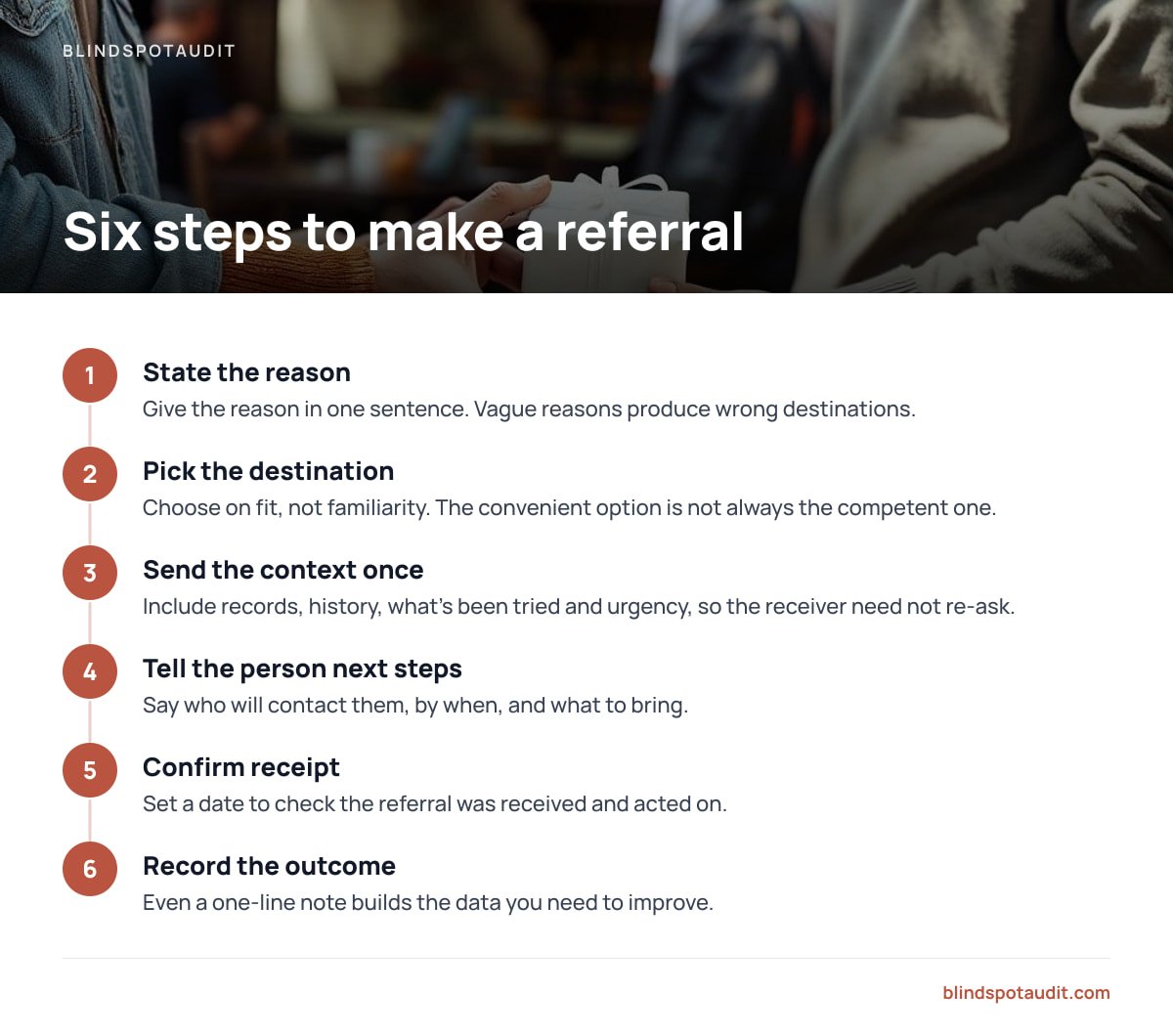
- State the reason in one sentence. "Persistent knee pain after six weeks of treatment" or "needs commercial-grade wiring we don't do." Vague reasons produce wrong destinations.
- Pick the destination on fit, not familiarity. The convenient option is not always the competent one.
- Send the context once. Records, history, what's been tried, urgency. The receiver should not need to re-ask the person you're sending.
- Tell the person what happens next. Who will contact them, by when, and what to bring.
- Confirm receipt. Set a date to check that the referral was received and acted on. This is the step most systems skip.
- Record the outcome. Even a one-line note builds the data you need to improve.
For a business owner, step five is where the money is. A warm introduction that nobody follows up in 48 hours goes cold.
Pro Tip: Track "asks per month," not referrals received. Referral volume is capped far more often by how rarely you ask than by how weak your reward is. If you can't say how many customers you asked last month, fix that number before you touch the incentive.
Customer Referral Systems: The Math That Decides If One Is Worth Building
Referrals have a documented quality advantage. A study in the Journal of Marketing by Schmitt, Skiera, and Van den Bulte, based on a bank's customer data, found that referred customers were more valuable than comparable non-referred customers, with better retention and margin. One company's data is not a law of nature, but it matches what most owners see: introduced customers arrive pre-sold and stay longer.
Whether a program is worth building comes down to arithmetic. Here is an illustration with made-up numbers:
- Average customer pays $2,000 a year at a 40% gross margin, so first-year gross profit is $800.
- Your paid acquisition cost for a similar customer is $300.
- A referral reward up to roughly $150 to $200, plus your time, still beats paid acquisition, with room left over.
Swap in your numbers. If your gross profit per customer is $90, a $50 reward leaves you nothing, and you'd be better off asking for introductions without a payout. Retention matters here too. If customers leave in months, referrals only multiply the leak, so check your customer retention rate before you promote anything.
Rewards, rules, and where the obvious move breaks
Two cautions. First, disclosure. The U.S. Federal Trade Commission's Endorsement Guides require that material connections, such as a reward for recommending a product, be clearly disclosed when someone promotes you publicly. Check the rules in each market you sell in.
Second, don't copy business reward tactics into healthcare. Paying for patient referrals can violate laws such as the U.S. federal Anti-Kickback Statute, which the HHS Office of Inspector General enforces. If you run a clinic, a "refer a friend, get a gift card" program needs a lawyer before it needs a logo.
Referral Coordinator: Do You Need a Degree?
Usually not. Requirements vary by employer and country, and I'd treat any claim of a single universal standard with suspicion. In most settings, a referral coordinator role asks for a high school diploma or equivalent plus relevant experience, with some employers preferring an associate degree or clinical background.
What matters more is the skill set:
- Scheduling and tracking. You are managing dozens of open loops at once.
- Authorization knowledge. Where insurers require approval, you need to know what's required, and what gets denied.
- Medical terminology. Enough to route a case correctly without a clinician rereading it.
- Persistence. Following up three times without annoying anyone is a craft.
My view: hire for follow-up discipline first and credentials second. A coordinator with a degree who lets referrals drift is worse than one without who confirms every one.
Why Referral Systems Fail, and the Case Where Rewards Make It Worse
The usual failures are boring.
- No owner. Everyone is responsible, so nobody checks.
- No confirmation step. The referral leaves, and no one knows if it arrived.
- Wrong measurement. Counting referrals sent, not completed.
- A reward bolted onto a weak base. If customers are lukewarm, a coupon doesn't make them advocates. It just makes the lukewarm ones loud about the coupon.
That last one is the case where the obvious answer is wrong. Owners whose growth has stalled often reach for a referral incentive first. But if your offer is vague or your customers don't clearly understand why you're different, nobody has a clear sentence to say when they refer you. Fix the sentence before the reward. Our guide to small business marketing covers the positioning work, and what's capping your business growth helps you tell whether referrals are even the right lever.
Get a Scored Read on Whether Your Customers Would Actually Refer You

If you're a small business owner, the question underneath this article is probably "why aren't more customers sending people my way?" Blindspotaudit answers that in about ten minutes. The Client Base audit ($67) scores how well you retain, understand, and re-engage customers, and tells you the one fix worth doing first. The USP & Positioning audit ($67) checks whether customers have a clear reason to recommend you. If you want all four areas (positioning, marketing, sales, customer base), the complete analysis is $197, with an optional $120 video review. There's also a free Blind Spot Checklist if you'd rather start without paying.
One honest limit: these are self-serve diagnostics. They tell you where the weak spot is and what to fix first, but they don't build or run your referral program, and they aren't designed for clinical referral workflows. If you're setting up patient referrals, you need a healthcare compliance specialist, not a business audit. For everyone else, the score is a cheap way to find out before you spend on rewards.
Frequently Asked Questions
What is your referral?
Your referral is the specific person, patient, or customer you are sending to someone better placed to help, or the one you have received. It includes the reason for sending them and any context the receiver needs. In practice, it is only complete once the receiver confirms it arrived.
What are the different types of referral systems?
Common groupings are vertical or horizontal (direction), routine, urgent, or emergency (urgency), and provider-initiated, self-referral, or payer-required (initiator). Systems are also either one-way or two-way, depending on whether information returns to the sender. Terminology varies by country and textbook, so confirm which definitions your organization uses.
Do you need a degree to be a referral coordinator?
Usually not, though it varies by employer and country. Many roles ask for a high school diploma or equivalent plus experience, and some prefer an associate degree or clinical background. Follow-up discipline, scheduling, and knowledge of authorization rules matter more than the credential.
How do you make referrals?
State the reason in one sentence, choose a destination based on fit, send the context once, and tell the person what happens next. Then confirm the referral was received and record the outcome. The confirmation step is where most referral systems break down.
What is a two-way referral system?
A two-way referral system sends the person forward and sends information back to whoever made the referral. In healthcare this is often called referral and counter-referral. It costs more administrative effort, but it lets the sender judge whether the destination is working.
Sources
- Primary health care fact sheet | World Health Organization
- Referral Programs and Customer Value | Journal of Marketing (SAGE)
- Endorsements, Influencers, and Reviews | U.S. Federal Trade Commission
- Fraud and Abuse Laws | HHS Office of Inspector General
Leave a Reply