

Business growth is a sustained increase in your company's revenue, profit, customers or capacity. The growth worth chasing is the kind that adds profit faster than it adds cost and complexity. Most stalled businesses are not short of effort or ideas. They are held back by one weak area: positioning, marketing, sales or customer retention. Find that constraint first, and every growth strategy you try after that works harder.
TL;DR:
- Business growth means more revenue, profit, customers or capacity, but revenue growth that shrinks your margin can make you poorer.
- Churchill and Lewis's five stages are existence, survival, success, take-off and resource maturity. Most small firms stall between survival and success.
- Growth is usually capped by one weak link, so spreading effort across ten tactics wastes money.
- The fastest levers are often pricing and retention. A 5% price rise on a 10% net margin lifts profit by half if volume holds.
- A business with $1 million in sales is valued on its owner earnings, not its revenue, and is often worth anywhere from about $200,000 to $750,000.
Table of Contents
- What Business Growth Actually Means, and the Kind That Makes You Poorer
- The Five Stages of Business Growth, and Where Owners Get Stuck
- Business Growth Strategies: Four Directions, Very Different Risk
- Why Business Growth Stalls at One Weak Link, Not Everywhere
- How to Grow Your Small Business Fast Without Buying More Leads
- Business Growth Examples: Three Owners, Three Different Bottlenecks
- What a Business With $1 Million in Sales Is Actually Worth
- Find the One Fix That Will Move Your Growth First
- Frequently Asked Questions
- Sources
What Business Growth Actually Means, and the Kind That Makes You Poorer
Business growth is a sustained increase in one or more of four things:
- Revenue
- Profit
- Number of customers
- Capacity to serve them
Most definitions stop at "getting bigger." The useful distinction is between growth that compounds and growth that costs you.
Revenue growth. Your sales go up. This is the number most owners watch, and it is the easiest to fake. You can buy it with discounts, ad spend or a big low-margin client.
Profit growth. What you keep goes up. This is the number that funds hiring, pays you properly and decides what the business is worth when you sell.
Customer growth. More people buy from you. This only helps if they stay long enough to repay what it cost to win them.
Capacity growth. You can serve more customers without the owner working more hours. This is what people usually mean by "scaling."
Plenty of owners grow revenue 40% in a year and end up with less cash. They took on clients at thin margins, hired ahead of demand, and absorbed the extra overhead themselves. If your revenue rose and your bank balance didn't, you did not grow. You got busier.
Revenue that grows faster than profit leaves you with a bigger version of the same problem.
The Five Stages of Business Growth, and Where Owners Get Stuck
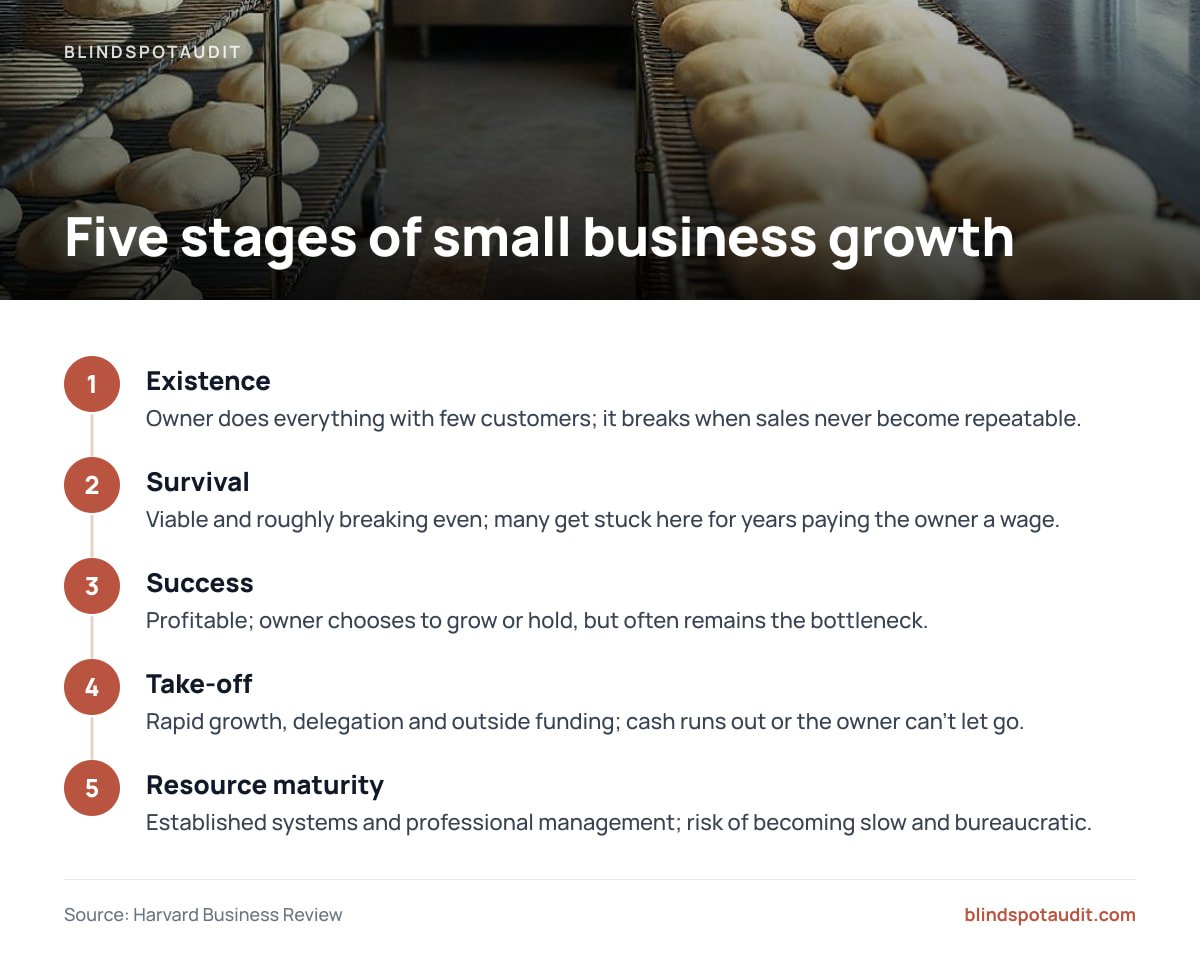
The most widely cited model comes from Neil Churchill and Virginia Lewis. Their 1983 article in the Harvard Business Review, "The Five Stages of Small Business Growth," describes how a company's problems change as it grows. It also explains why the owner's role has to change with them.
| Stage | What it looks like | The question you're answering | Where it typically breaks |
|---|---|---|---|
| 1. Existence | Owner does everything, few customers | Can we win enough customers to stay alive? | Never reaching repeatable sales |
| 2. Survival | Viable, roughly breaking even | Can we cover costs and fund replacement equipment? | Stuck here for years, paying the owner a wage and little else |
| 3. Success | Profitable; the owner chooses whether to grow or hold | Do we stay comfortable or push for growth? | Owner remains the bottleneck for sales and decisions |
| 4. Take-off | Rapid growth, delegation, outside funding | How do we grow fast and finance it? | Cash runs out, or the owner can't let go |
| 5. Resource maturity | Established systems, professional management | How do we keep the agility that got us here? | Becomes slow and bureaucratic |
Most small businesses that feel "stuck" are sitting in the survival stage. They are profitable enough to continue but not profitable enough to reinvest. Churchill and Lewis's point still holds: what got you through one stage will hold you back in the next. In the existence stage, the owner doing all the selling is a strength. In the success stage, it is the ceiling.
Survival is a real filter. U.S. Bureau of Labor Statistics data on establishment age and survival show that roughly one in five new businesses is gone within its first year. About half are gone by year five.
Business Growth Strategies: Four Directions, Very Different Risk
Almost every growth strategy fits into the matrix H. Igor Ansoff published in 1957. It sorts your options by whether you are selling new or existing products, to new or existing markets.
| Strategy | What you do | Risk | Speed to results |
|---|---|---|---|
| Market penetration | Sell more of what you have to the customers you already serve | Lowest | Fastest |
| Market development | Take existing products to new customer types or regions | Medium | Medium |
| Product development | Build new offers for the customers you already have | Medium | Medium |
| Diversification | New products for new markets | Highest | Slowest |
Our position: start with market penetration and stay there longer than feels exciting. Most owners jump to a new product or a new market because their current one feels "tapped out." Usually it isn't tapped out. It is under-converted, under-priced or leaking customers.
Diversification is the strategy most likely to fail for a small business. It splits your attention exactly when focus matters most. If you can't explain why your current customers choose you over alternatives, you will not explain it any better to a market you have never sold to.
Why Business Growth Stalls at One Weak Link, Not Everywhere

The idea that one constraint limits a whole system comes from Eliyahu Goldratt's theory of constraints. It applies closely to small businesses: your growth is capped by your weakest commercial function, not your average one.
Improving a strong area while a weak one stays broken produces nothing. Doubling your leads does not help if your sales process converts one in fifty. Doubling conversions does not help if half your new customers leave within a year.
In most small businesses, the constraint sits in one of four places:
- Positioning. Prospects can't tell why they should pick you, so every sale becomes a price fight.
- Marketing. Too few of the right people know you exist, or your message attracts the wrong ones.
- Sales. Enough interested people show up, but too few become paying customers.
- Client base. You win customers but lose them, or depend on a handful who could leave at any time.
| Symptom you're seeing | Likely constraint | First thing to check |
|---|---|---|
| Constant discounting, "you're too expensive" | Positioning | Can a customer say, in one sentence, why you over a competitor? |
| Quiet pipeline, referral-only growth | Marketing | Where did your last 20 customers actually come from? |
| Lots of quotes, few wins | Sales | Your quote-to-close rate, and how fast you follow up |
| Busy year after year but revenue flat | Client base | What share of last year's customers bought again this year? |
| One client is over 25% of revenue | Client base | What happens to profit if they leave next month |
Pro Tip: Diagnose from your last 20 lost deals, not your last 20 wins. Wins tell you what you do well. Losses tell you where the constraint is. Ask, or work out, why each lost prospect said no. If more than half cite price, your real problem is usually positioning, not pricing. Prospects only weigh price heavily when they can't see a difference worth paying for.
How to Grow Your Small Business Fast Without Buying More Leads

The fastest way to grow a small business is rarely "get more customers." New customers are the slowest and most expensive lever you have. The quicker levers are price, retention and conversion, and they work on the customers already in front of you.
Raise prices before you raise spend
Take a business with $1 million in revenue and a 10% net margin, which means $100,000 in profit. Raise prices 5% and keep the same customers. Revenue rises to $1.05 million and costs barely move, so profit rises to about $150,000.
To earn that same extra $50,000 through new sales at a 10% margin, you would need roughly $500,000 in additional revenue. That is half again your current size.
A 5% price rise on a business with a 10% net margin lifts profit by 50%, assuming you keep your customers. Earning the same profit from new sales takes 50% more revenue.
The caveat is real: you will lose some price-sensitive customers. But at a 10% margin, you could lose nearly a third of your sales volume after a 5% rise and still make the same profit. Few owners lose anywhere near that.
Stop the leak
Customer retention is the second-fastest lever. Research by Frederick Reichheld of Bain & Company is summarized in a Harvard Business Review article on the value of keeping customers. It found that increasing retention rates by 5% increases profits by 25% to 95%.
The math is simple. If you lose 30% of your customers every year, your first 30% of new sales each year just replaces them. That growth never shows up.
Fix conversion before traffic
If you send 100 quotes a month and win 15, lifting your close rate to 20% is a one-third increase in new business. You get it with zero extra marketing spend. Two things usually move the close rate:
- Faster follow-up. Respond within hours, not days.
- A clearer next step. Every quote should tell the prospect exactly what to do to say yes.
Both work on the leads you already have.
Only once price, retention and conversion are sound does spending on lead generation pay back properly. Pour leads into a leaky funnel and you are paying to fill it twice.
Business Growth Examples: Three Owners, Three Different Bottlenecks
These are composite examples, not named clients. They show how the same complaint, "we're not growing," can have completely different causes.
The busy contractor. A landscaping firm with $800,000 in revenue had a full calendar and flat profit for three years. The owner wanted a second crew. The real constraint was positioning. They were quoting against every low-cost operator in town because their website and proposals looked identical to everyone else's. Leading with their warranty and a fixed-start-date guarantee let them raise prices instead of headcount.
The agency with a great reputation. A marketing agency grew to $1.2 million almost entirely through referrals, then stalled. Its sales process was fine and its clients stayed. The constraint was marketing. There was no channel bringing in anyone who hadn't already heard of them, so growth was capped by how many friends their clients had.
The subscription box. An online retailer was acquiring 400 new subscribers a month and celebrating. Its average subscriber left after 2.5 months, so it was spending most of its ad budget to stand still. The constraint was the client base. A better first-box experience did more for growth than any ad campaign.
The same symptom needed three different fixes. That is why generic "8 tips to grow your business" lists so rarely work: they hand you the fix before anyone has found the problem.
What a Business With $1 Million in Sales Is Actually Worth
Revenue alone tells you surprisingly little about value. Small owner-operated businesses are usually valued on seller's discretionary earnings (SDE). SDE is the profit plus the owner's salary and personal perks run through the business. Brokers then multiply SDE by a figure that, for many main-street businesses, commonly falls between about 2 and 3. Larger companies are more often valued on a multiple of EBITDA.
So two businesses with identical $1 million in sales can be worth very different amounts:
- Business A: SDE of $100,000, heavily dependent on the owner, one big client. At 2x, it is worth about $200,000.
- Business B: SDE of $250,000, a team that runs day-to-day operations, recurring customers. At 3x, it is worth about $750,000.
The same factors that cap growth also cap valuation:
- Owner dependence
- Customer concentration
- Weak margins
- High churn
Fixing your growth constraint is also the most direct way to raise what your business would sell for. For a real figure, get a formal valuation. Industry, location and deal terms all move the multiple.
Find the One Fix That Will Move Your Growth First

If this article has a single takeaway, it's that growth stalls at one weak link. Guessing which one is expensive. Blindspotaudit gives you a scored, ten-minute self-assessment for each of the four areas covered above: USP and positioning, marketing, sales, and client base. Each audit costs $67 and returns a plain-English score plus the one fix worth doing first. There is no sales call and no consultant's invoice. If you don't know which area is the problem, the complete analysis of all four is $197. You can add a $120 video review if you want someone to walk through your results with you. The free Blind Spot Checklist is a place to start.
One limit: it is a self-assessment, so the score is only as accurate as your answers. If you rate your own sales process generously, the audit will too. It is also not a valuation or a financial review. Use it to find where to look first, then look properly.
Frequently Asked Questions
What does business growth mean?
Business growth is a sustained increase in a company's revenue, profit, customer numbers or capacity to serve customers. The growth that matters most is profit growth, because revenue that rises faster than costs can leave the business with less cash than before. Healthy growth also means the business can serve more customers without the owner working proportionally more hours.
What are the five stages of business growth?
Neil Churchill and Virginia Lewis's widely cited model, published in Harvard Business Review in 1983, names five stages: existence, survival, success, take-off and resource maturity. Each stage brings different problems and demands a different role from the owner. Many small businesses stay stuck in the survival stage, profitable enough to continue but not enough to reinvest.
How do I grow my small business fast?
The fastest levers are usually pricing, customer retention and sales conversion, not more leads. For a business with a 10% net margin, a 5% price increase lifts profit by about 50% if customers stay. Fix the weakest of your positioning, marketing, sales and client retention first, then spend on lead generation.
How much is a business worth with $1,000,000 in sales?
It depends on profit and owner dependence, not revenue. Small businesses are commonly valued at roughly 2 to 3 times seller's discretionary earnings, so a $1 million business earning $100,000 for its owner might be worth around $200,000. One earning $250,000 with a team in place could be worth around $750,000.
What are the main business growth strategies?
Most strategies fit Ansoff's four categories: market penetration, market development, product development and diversification. Market penetration, meaning selling more of what you already offer to the customers you already serve, is the lowest-risk and fastest to show results. Diversification into new products and new markets carries the highest risk for small businesses.
Leave a Reply